

ITFM vs. TBM vs. FinOps: What's the Difference?
Quick Answer:
IT Financial Management (ITFM), Technology Business Management (TBM), and FinOps are frameworks designed to optimize IT financial management. While ITFM focuses on financial processes and practices, TBM focuses on transparency and the allocation of technology costs, and FinOps brings a collaborative approach to financial management in cloud environments.
TL;DR
- ITFM: Focuses on traditional IT financial management, covering budgets and forecasts.
- TBM: Provides visibility and control over technology costs, promoting efficiency.
- FinOps: Brings finance and operations teams together to optimize cloud spending.
- Each framework has a different focus, but they all aim to improve financial management in IT.
- The choice between them depends on the organization's specific needs.
ITFM, TBM, and FinOps Side by Side
The three disciplines address different problems and coexist. The table below summarizes where each one is applied, who its target audience is, and at what pace each one operates.
| Dimension | ITFM | TBM | FinOps |
|---|---|---|---|
| Scope | The entire IT budget: hardware, software, personnel, data center, telecommunications | All technology spending, including shadow IT, mapped to business products and services | It started out as a 100% public cloud; since 2025, it has also covered SaaS, data centers, licensing, and AI |
| Unit of analysis | Cost Center and General Ledger Account | Cost Pool → Tower → Solution → Consumer | Cloud resources and unit economics (cost per transaction, per customer) |
| Primary audience | CFO, Controllership, Budget Owners | CIO and CFO — the common language between IT and the business | Engineering, FinOps practitioners, and finance, working together |
| Cadence | Annual and quarterly, within the budget cycle | Monthly and quarterly, with benchmarking and showback | Daily or nearly real-time |
| Who Governs | No specific guidelines of its own; it is based on ITIL 4 and ISO/IEC 20000-1 | TBM Council, an independent nonprofit organization since 2012 | FinOps Foundation, part of the Linux Foundation |
| Benchmark | There is no single mandatory standard | TBM Taxonomy, Version 5.0.1 (July 2025) | FinOps Framework, 2025 and 2026 Revisions |
| A question that answers itself | “How much does IT cost, and is the budget finalized?” | “What business capabilities does this expenditure support?” | “Can we spend less per unit delivered now?” |
A common saying in the industry sums up the division of labor well: ITFM provides financial accuracy, TBM provides business context, and FinOps provides operational speed. In practice, ITFM is often treated as a foundational capability within TBM, and FinOps as an extension of the discipline into the cloud era.
It's not about choosing one of the three
Convergence is no longer just a consulting firm’s opinion—it has become official doctrine: the 2026 revision of the FinOps Framework now explicitly addresses the overlap with ITSM, ITAM, ITFM, sustainability, security, and enterprise architecture. The FinOps Foundation itself maintains a working group dedicated to the coexistence of FinOps and TBM.
What is IT Financial Management (ITFM)?
IT Financial Management (ITFM) is a set of practices and processes designed to manage and optimize an organization’s information technology costs. The primary focus of ITFM is the creation of budgets, forecasts, and financial reports that help IT teams better understand their spending and align those expenditures with business objectives.
In Brazil, where many companies are undergoing digital transformation, IT financial management has become crucial. With the growing reliance on digital technologies and services, it is essential that IT leaders have a clear understanding of how resources are being allocated and what the returns on these investments are.
Key Components of the ITFM
- Budgeting and Forecasting: Preparing annual budgets and forecasting expenses.
- Financial Reports: Generation of detailed reports on IT costs and investments.
- Cost Analysis: Identifying areas where costs can be optimized.
- Alignment with Strategy: Ensure that IT spending is aligned with the organization’s business objectives.
What is Technology Business Management (TBM)?
Technology Business Management (TBM) is a relatively new approach designed to provide a framework for managing technology costs, enabling organizations to better understand the value they are deriving from their IT investments. TBM is distinguished by its emphasis on transparency and cost allocation, helping companies see how every dollar spent on technology impacts business results.
This approach is particularly relevant in Brazil, where companies are seeking ways to increase the efficiency and effectiveness of their IT operations. TBM enables IT teams to communicate more effectively with other business units, fostering a culture of collaboration and accountability.
TBM Features
- Cost Model: Provides a clear model for allocating and tracking IT costs.
- Transparency: Makes it easier to understand the costs and benefits associated with technology investments.
- Performance Metrics: Provides metrics that help evaluate the performance of technology investments.
- Interdepartmental Collaboration: Promotes interaction between IT and other departments, such as finance and operations.
What is FinOps?
FinOps, or Financial Operations, is a framework that combines financial practices with technology operations, particularly in cloud environments. The goal of FinOps is to enable IT and finance teams to collaborate effectively to optimize cloud spending, ensuring that organizations get the most value from their investments.
Unlike ITFM and TBM, which take a more traditional, IT-focused approach, FinOps is highly dynamic and adaptable, reflecting the agile nature of cloud environments. In Brazil, where many companies are migrating to the cloud, implementing FinOps practices is essential to ensuring effective cost control.
Principles of FinOps
- Collaboration: Promotes collaboration between finance and operations teams.
- Visibility: Provides real-time visibility into cloud spending.
- Accountability: Establishes accountability among teams for managing costs.
- Continuous Optimization: Promotes the continuous optimization of cloud spending.
The Numbers Behind Convergence
So far, the text has been conceptual. The data below show why this discussion moved beyond theory and became an agenda item for the board—and they are the reason why the three disciplines are no longer kept in separate silos.
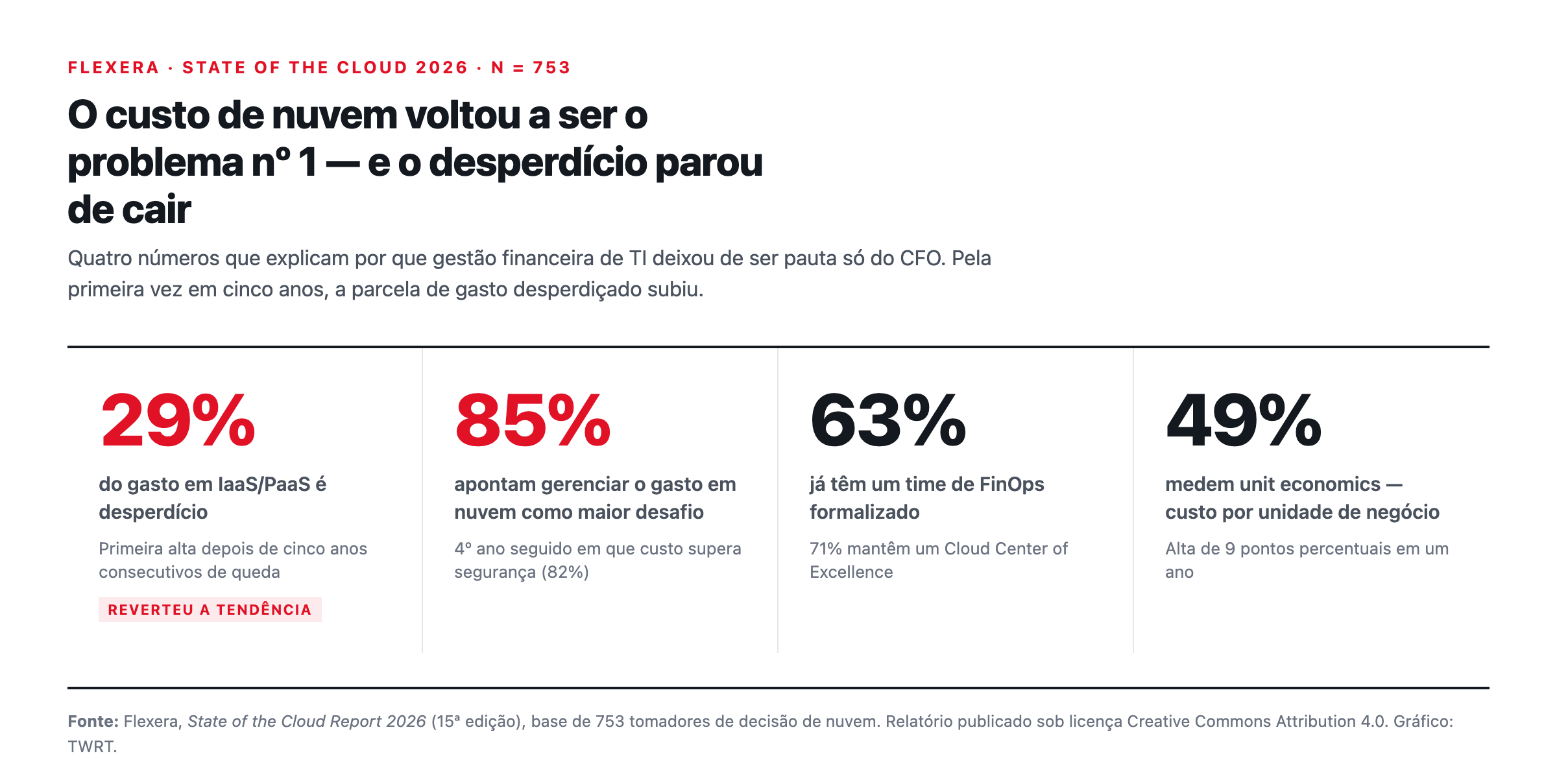
Two figures are worth noting. The first is the 29% waste in IaaS and PaaS: after five consecutive years of decline, this metric has begun to rise again—advances in AI and new managed services have created a category of spending that teams have not yet learned to optimize. The second is that cloud costs have surpassed security as the biggest challenge for the fourth year in a row, reversing a decade in which security had been the top concern.
On the other hand, the ability to respond has matured: 63% of organizations already have a formal FinOps team, and 49% measure unit economics—a 9-percentage-point increase in one year. Measuring cost per business unit is precisely the bridge between the language of FinOps and that of TBM.
FinOps is no longer just a cloud-related topic
The most significant change over the past two years has been in scope. The 2025 FinOps Framework introduced the concept of Scopes —public cloud, SaaS, data center, licensing, and AI—and removed the word “cloud” from the names of two of its domains. The 2026 revision added the capability “Executive Strategy Alignment.” In practice, this expansion has already taken place:
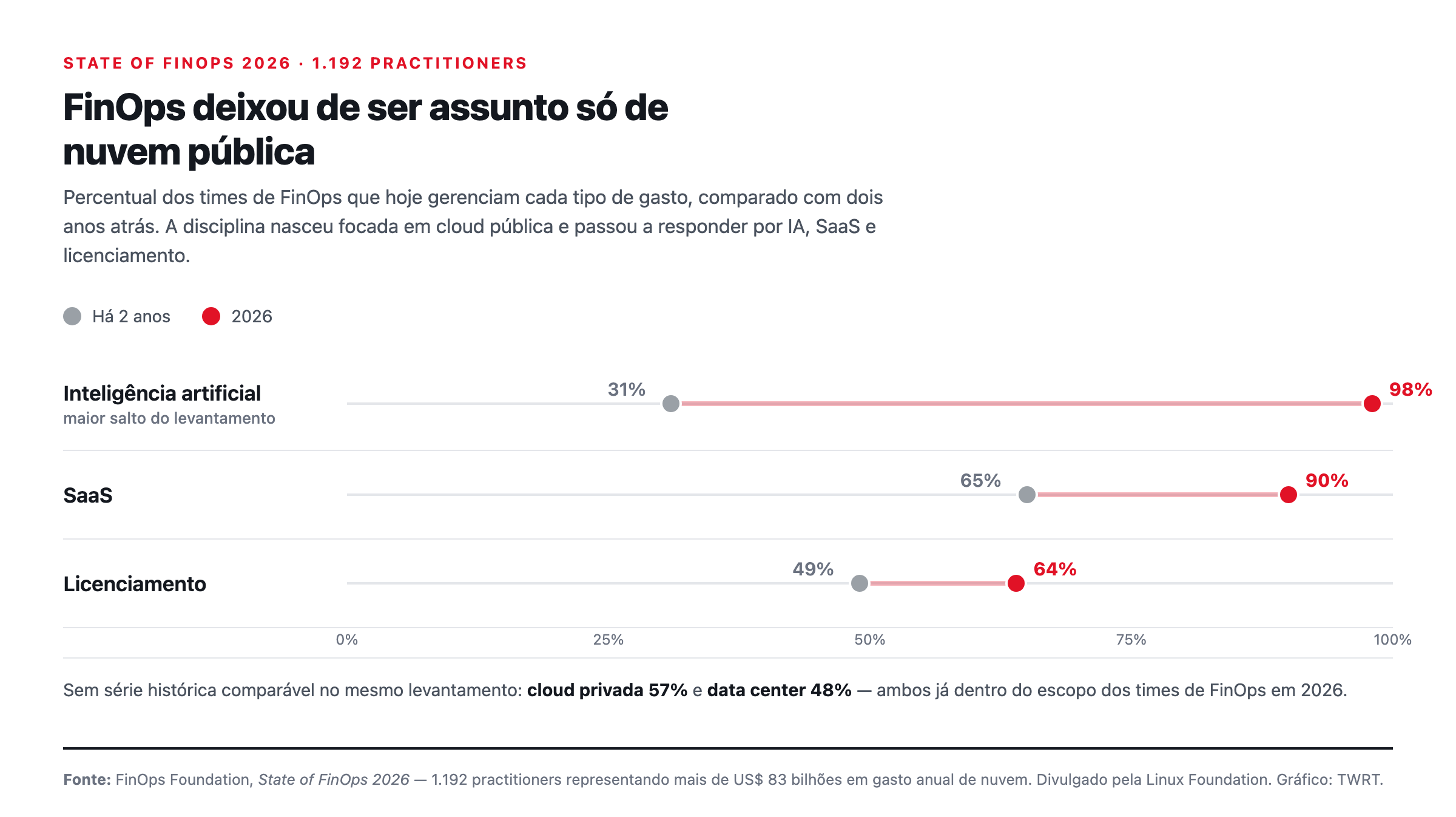
With 98% of FinOps teams already accounting for AI spending—up from 31% two years ago—the traditional divide between “FinOps handles the cloud” and “ITFM handles the rest” has disappeared. Another sign pointing in the same direction: 78% of FinOps teams today report to the CTO or CIO, rather than to the finance department.
What TBM has standardized
On the TBM side, the reference is TBM Taxonomy 5.0.1, published in July 2025. It organizes spending into four interlinked layers— Technology Cost Pools (the accounts: personnel, external services, cloud, hardware, software and SaaS, data center, telecommunications), Technology Resource Towers (infrastructure, applications, operations, devices), Technology Solutions (what IT delivers, including a separate category for artificial intelligence), and Technology Consumers (who consumes it). The analogy used in the document itself is straightforward: the taxonomy is to technology costs as accounting standards are to financial reports.
It’s worth noting a point that often raises questions: the TBM Council is an independent organization, established as a nonprofit in 2012. Apptio—now part of IBM—is a sponsor and technical advisor, not the owner.
For Those Who Are Technicians
For technology and finance professionals, understanding the differences and similarities between ITFM, TBM, and FinOps is crucial. Each framework offers different tools and methodologies that can be applied depending on the organization’s context:
- ITFM is ideal for companies seeking a structured approach to IT financial management, with a focus on budgets and forecasts.
- TBM is also best suited for organizations that need greater visibility into technology costs and want to foster a culture of collaboration between IT and other departments.
- FinOps is ideal for companies that are adopting the cloud and need an agile, collaborative approach to managing expenses.
Implementation Checklist
- Set Objectives: Define the objectives the organization aims to achieve with the chosen framework.
- Choose a Framework: Decide between ITFM, TBM, or FinOps based on your specific needs.
- Bring Stakeholders Together: Involve all stakeholders from the very beginning of the process.
- Team Training: Provide appropriate training for the IT and finance teams.
- Establish Processes: Create clear processes for IT financial management.
- Use Tools: Implement tools that support the chosen framework.
- Monitor Performance: Establish metrics to evaluate IT’s financial performance.
- Adjust Strategies: Review and adjust strategies as needed to optimize results.
- Promote a Culture of Responsibility: Encourage financial responsibility among teams.
- Conduct Periodic Reviews: Regularly review processes and results to ensure continuous improvement.
If You Only Do 3 Things…
- Identify Your Model: Determine which framework (ITFM, TBM, or FinOps) best suits your organization’s needs.
- Engage Stakeholders: Involve the IT and finance teams from the outset to ensure alignment.
- Implement the Right Tools: Use tools that support the implementation of your chosen framework.
FAQs
- What is the main difference between ITFM and TBM?
-
ITFM focuses on traditional financial management, while TBM offers a more transparent and collaborative approach to technology cost allocation.
-
Which is better suited for cloud environments: ITFM or FinOps?
-
FinOps is best suited for cloud environments because it integrates financial practices with operations to optimize spending.
-
How do you choose between the three frameworks?
-
The choice depends on the organization's specific needs, whether the focus is on financial control or visibility and collaboration.
-
Is it possible to integrate the three frameworks?
-
Yes, many organizations use a combination of the three frameworks to meet their specific needs.
-
What tools are recommended for implementing FinOps?
- There are several tools on the market, such as CloudHealth, CloudCheckr, and Spot.io, that can help with the implementation of FinOps practices.
Final CTA
If your company is ready to optimize its IT financial management and needs support in implementing ITFM, TBM, or FinOps, please contact TWRT. Our team of experts is ready to help you transform your approach to IT finance and maximize your results.


